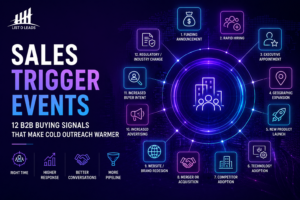
Sales Trigger Events: 12 B2B Buying Signals That Make Cold Outreach Warmer
Cold outreach often fails for one simple reason:
The message arrives at the wrong time.
A company might perfectly match your Ideal Customer Profile (ICP), but that doesn’t mean it needs your solution today.
Now imagine contacting the same company immediately after it raises funding, appoints a new executive, expands into a new market, or starts aggressively hiring.
The prospect hasn’t changed.
The timing has.
These changes are known as sales trigger events—business signals that can indicate a new problem, priority, budget, or purchasing opportunity.
For B2B sales teams, identifying these signals can transform generic cold outreach into timely, context-driven conversations.
What Are Sales Trigger Events?
Sales trigger events are changes or activities within a company that can indicate a potential need for a product or service.
Examples include:
Funding announcements
Executive appointments
Rapid hiring
Company expansion
Product launches
Technology changes
Mergers and acquisitions
Trigger events don’t guarantee that a company is ready to purchase.
Instead, they answer an important prospecting question:
“Why might this company need us now?”
This makes trigger-based prospecting particularly useful when combined with accurate B2B data, buyer intent signals, and lead scoring.
Why Are Sales Trigger Events Important?
Traditional prospecting often starts with static information.
You identify companies based on:
Industry
Revenue
Employee count
Location
Technology
Decision-maker role
That tells you whether an account fits your target market.
But it doesn’t tell you whether something has recently changed.
Consider two SaaS companies with 100 employees.
Both fit your ICP.
Company A has operated at roughly the same size for two years.
Company B just raised $15 million and posted 30 new jobs.
Which account deserves immediate research?
Probably Company B.
The funding and hiring activity suggest that the organization is entering a period of change—and change often creates new purchasing requirements.
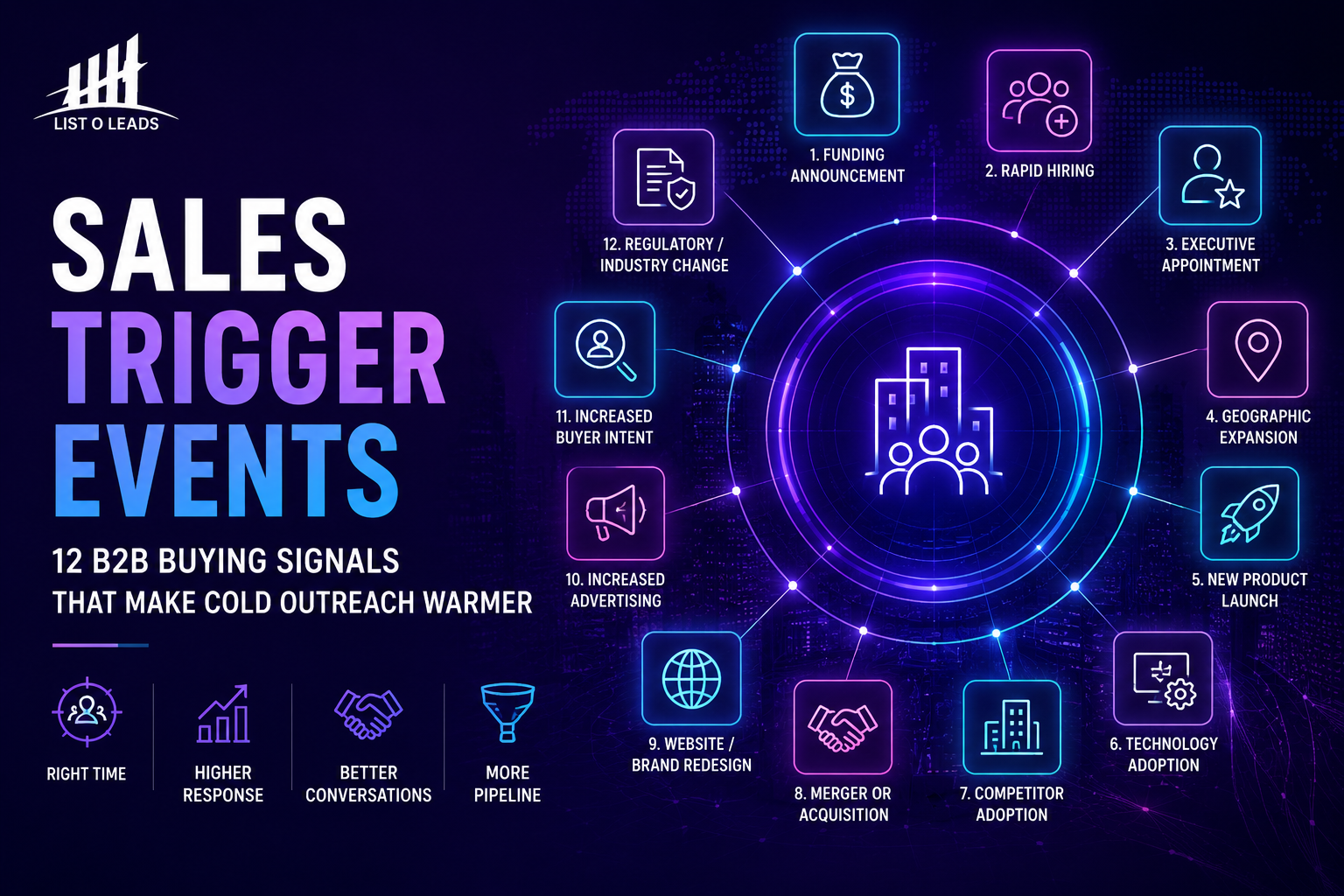
12 B2B Sales Trigger Events Worth Tracking
Not every business event deserves immediate outreach. The following 12 signals are particularly useful for B2B prospecting.
1. Recent Funding
Funding is one of the clearest sales triggers for growing companies.
A funding round may lead to investment in:
New employees
Marketing
Sales infrastructure
Technology
Operations
Professional services
The key isn’t simply saying:
“Congratulations on your funding.”
Instead, determine what the company is likely to do because of the funding.
A company planning to triple its sales organization may need recruiting, CRM, sales intelligence, lead generation, automation, or training solutions.
That creates a more meaningful sales conversation.
2. Rapid Hiring
Hiring activity can reveal where a business is investing.
If a company suddenly advertises 25 sales positions, that’s valuable intelligence for businesses selling:
B2B lead generation
Sales software
CRM solutions
Training
Recruiting
Data services
Automation
Don’t just count job openings.
Look at which departments are growing.
That provides context about the company’s priorities.
3. New Executive Appointment
A newly appointed CEO, CMO, VP of Sales, CTO, or Operations Director often enters with new objectives.
New leaders may:
Review existing vendors
Change technology
Reorganize teams
Introduce new processes
Increase investment
Replace underperforming systems
This creates an important window for relevant outreach.
4. Geographic Expansion
Opening a new location or entering a new market can create immediate operational requirements.
Expansion may require:
New prospect databases
Local marketing
Recruitment
Logistics
Technology
Advertising
Sales development
For lead generation companies, geographic expansion is particularly valuable because the business may need an entirely new audience.
5. New Product or Service Launch
A new offering usually needs customers.
That makes product launches useful trigger events for companies providing:
Advertising
Lead generation
Market research
Sales development
Content marketing
PR
Analytics
Instead of pitching generic marketing services, connect your offer directly to the new product’s go-to-market requirements.
6. Technology Adoption
Changes in a company’s technology stack can reveal new opportunities.
Suppose a company adopts a major CRM platform.
That could create demand for:
Integrations
Data enrichment
Automation
Consulting
Sales intelligence
CRM implementation
Technology changes can also reveal whether a prospect is compatible with your solution.
7. Competitor Adoption
Sometimes the strongest trigger isn’t happening at the prospect’s company.
It’s happening with their competitors.
If several competitors adopt a particular technology or strategy, other businesses in the sector may start evaluating similar solutions.
This can create an opportunity to lead with industry context rather than a generic pitch.
8. Merger or Acquisition
Mergers and acquisitions create substantial organizational change.
Companies may need to consolidate:
Technology platforms
Databases
Vendors
Sales teams
Marketing systems
Operational processes
M&A events can therefore create opportunities across software, consulting, data, HR, finance, marketing, and professional services.
9. Website or Brand Redesign
A major website redesign or rebrand can signal broader changes in marketing strategy.
The company may be:
Entering a new market
Repositioning itself
Launching new products
Increasing advertising
Modernizing its sales funnel
For marketing and growth providers, this can be an excellent conversation starter.
10. Increased Advertising Activity
A company suddenly increasing its advertising presence is signaling something important:
It wants more customers.
That creates potential opportunities for businesses offering:
Lead generation
Conversion optimization
Data services
Programmatic advertising
Analytics
Sales development
For a deeper understanding of automated audience targeting, read our guide to Traditional vs. Programmatic Advertising Strategy.
11. Increased Buyer Intent
Sometimes the trigger isn’t a corporate announcement.
It’s behavior.
A target account might begin:
Researching relevant topics
Visiting solution pages
Comparing vendors
Consuming more content
Returning to your website
These are buyer intent signals.
Our guide to B2B Intent Data explains how businesses can use these signals to identify prospects before they make direct contact.
When strong intent appears alongside another trigger event, the account may deserve even higher priority.
12. Regulatory or Industry Change
External events can create demand across an entire market.
Examples include:
New regulations
Compliance requirements
Privacy changes
Technology disruption
Economic shifts
Industry standards
These triggers are powerful because one event may create opportunities across hundreds or thousands of target companies simultaneously.
Sales Triggers vs. Buyer Intent: What’s the Difference?
These concepts are related but not identical.
Sales trigger events tell you that something has changed.
Buyer intent signals suggest that someone may be researching a solution.
For example:
A company raises funding.
That’s a trigger event.
The same company begins researching sales automation platforms.
That’s an intent signal.
Now suppose the company also matches your ICP.
You have:
Strong Fit + Trigger Event + Buyer Intent
That’s substantially more useful than simply knowing the company’s industry and employee count.
How to Use Trigger Events in B2B Prospecting
Finding a signal isn’t enough. You need a process for turning it into action.
Step 1: Define Your ICP
First determine which companies you actually want.
Filter by criteria such as:
Industry
Geography
Revenue
Company size
Technology
Business model
This prevents your team from chasing interesting events at irrelevant companies.
Step 2: Choose Triggers Relevant to Your Offer
Different businesses should track different signals.
A recruiting company might prioritize hiring growth.
A lead generation provider might prioritize funding, expansion, new sales leadership, and product launches.
A cybersecurity company might prioritize technology changes and regulatory events.
Track signals that have a logical relationship with why customers buy your solution.
Step 3: Find the Right Decision-Maker
Once a relevant company is identified, determine who owns the problem.
That could be:
CEO
Founder
Sales Director
CMO
Head of Growth
Operations Director
CTO
Revenue Operations leader
Good timing with the wrong contact is still poor prospecting.
Step 4: Prioritize the Opportunity
Not every trigger deserves the same attention.
You can combine trigger events with AI lead scoring to rank prospects based on fit, behavior, and timing.
Read AI Lead Scoring: How to Prioritize B2B Prospects Most Likely to Convert to understand how this prioritization works.
Step 5: Personalize the Outreach
The trigger should provide context—not become a gimmick.
Avoid:
“I saw you raised funding. Do you need leads?”
Instead, connect the event to a likely business challenge:
“I saw your team is expanding its sales operation. Growth at that stage often creates pressure to keep new reps supplied with enough qualified prospects.”
Now your message has a reason to exist.
Where Can You Find B2B Sales Trigger Events?
Sales teams can discover triggers through several sources:
Company websites
LinkedIn
Job boards
Press releases
Funding databases
Industry publications
CRM activity
Website analytics
Intent data platforms
Technology intelligence tools
AI can also help teams monitor large numbers of accounts, classify signals, and prioritize relevant changes.
For additional ways AI is changing modern marketing workflows, explore Top AI Tools Every Marketer Should Know.
Common Trigger-Based Prospecting Mistakes
Trigger events improve timing, but poor execution can still kill the opportunity.
Avoid:
Contacting every company with a trigger
Ignoring ICP fit
Using outdated contact information
Sending generic automated messages
Mentioning irrelevant events
Waiting too long after a trigger occurs
Treating a trigger as proof that someone will buy
The objective isn’t to manufacture urgency.
It’s to identify legitimate reasons why outreach may be relevant now.
Sales Trigger Events FAQ
What is a sales trigger event?
A sales trigger event is a change within or around a company that may create a new business need or purchasing opportunity.
What are examples of B2B buying signals?
Funding, hiring, executive changes, expansion, technology adoption, product launches, increased advertising, and buyer research activity can all function as B2B buying signals.
Are sales triggers the same as intent data?
No. Trigger events identify business changes, while intent data generally focuses on behavioral signals associated with research or interest. Combining both can improve prospect prioritization.
How quickly should sales teams act on a trigger?
It depends on the event, but relevant triggers generally become less valuable as they age. Sales teams should research high-value events quickly and engage when there is a legitimate connection between the event and their solution.
Make Cold Outreach About Timing, Not Just Volume
Successful B2B prospecting requires more than finding companies that match a database filter.
You need to understand:
Who fits your market?
What changed?
Is there evidence of buying intent?
Who owns the problem?
Why should you contact them now?
Sales trigger events help answer that final question.
When you combine accurate B2B data + ICP fit + intent signals + trigger events + lead scoring, cold outreach becomes more targeted, relevant, and actionable.
Find the Right Prospects at the Right Time
Your sales team doesn’t need thousands of random contacts.
It needs the right companies, the right decision-makers, and better reasons to start conversations.
List O Leads helps businesses build targeted B2B lead generation strategies designed to connect sales teams with relevant prospects and stronger opportunities.
Get Started With List O Leads and turn smarter targeting into a stronger sales pipeline.