AI Lead Scoring: How to Prioritize B2B Prospects Most Likely to Convert
Your sales team has 2,000 prospects.
Which 20 should they contact first?
That question is harder than it sounds.
Traditional sales teams often prioritize leads using basic information such as company size, job title, industry, or a few manually assigned CRM points. The problem is that two prospects can look nearly identical on paper while having completely different probabilities of becoming customers.
One might simply match your target market.
The other might match your target market and be researching solutions, visiting important pages, engaging with content, expanding its team, and showing other buying signals.
Treating those prospects equally wastes valuable sales time.
AI lead scoring helps B2B teams analyze multiple prospect signals and prioritize the leads most likely to deserve immediate attention.
Instead of asking sales representatives to work through enormous lists from top to bottom, AI can help answer a much better question:
Who should we contact next—and why?
What Is AI Lead Scoring?
AI lead scoring is the use of artificial intelligence and machine learning to evaluate prospect data, behavioral signals, engagement, and historical patterns to estimate which leads are most likely to convert.
Traditional lead scoring normally uses fixed rules.
For example:
Director-level title: +10 points
Company has 100+ employees: +10
Downloaded an ebook: +5
Visited pricing page: +15
Requested a demo: +30
A prospect accumulating enough points becomes a Marketing Qualified Lead (MQL) or Sales Qualified Lead (SQL).
This system can work, but it has an obvious limitation:
Humans decide beforehand which actions matter and exactly how much each action is worth.
AI lead scoring can analyze much larger combinations of data and identify patterns that may not be obvious through manually created rules.
How Does AI Lead Scoring Work?
AI lead scoring generally combines several categories of prospect information.
1. Firmographic Data
This determines whether the company resembles your ideal customer.
Signals may include:
Industry
Company size
Annual revenue
Geography
Business type
Growth stage
2. Contact Data
The system can evaluate whether you’ve identified an appropriate person within the organization.
Examples include:
Job title
Department
Seniority
Decision-making authority
Role relevance
A CEO at a five-person company and a marketing coordinator at a 5,000-person enterprise may require completely different scoring logic.
3. Behavioral and Intent Data
This adds information about what prospects appear to be doing.
Signals might include:
Website visits
Pricing-page views
Product research
Content downloads
Email engagement
Demo activity
Competitor research
Repeat visits
These signals can be especially useful because they add timing to otherwise static prospect information.
Our guide to B2B Intent Data explains how these signals can help businesses identify buyers before they contact you.
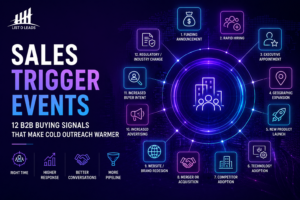
4. Sales Trigger Events
AI scoring can also incorporate changes happening inside target companies.
For example:
New funding
Rapid hiring
Executive changes
Geographic expansion
New product launches
Mergers or acquisitions
Technology changes
A trigger event may substantially change the probability that a company needs your solution.
5. Historical Conversion Data
This is where AI scoring can become particularly useful.
Instead of looking only at the current prospect, AI can analyze characteristics shared by previous:
Qualified leads
Opportunities
Customers
Closed deals
Lost opportunities
The model can then identify patterns associated with successful conversions.
AI Lead Scoring vs. Traditional Lead Scoring
Traditional lead scoring is primarily rule-based.
AI lead scoring is more pattern-driven and adaptive.
Consider this simplified example.
Traditional Model
A Marketing Director receives:
Correct industry: +10
250 employees: +10
Ebook download: +5
Score: 25
Another prospect receives:
Correct industry: +10
250 employees: +10
Pricing-page visit: +15
Score: 35
The rules determine the outcome.
AI-Assisted Model
An AI model could potentially consider additional relationships:
Company profile
Decision-maker seniority
Website behavior
Recent engagement
Previous CRM activity
Trigger events
Similarity to past customers
Historical conversion patterns
Instead of simply producing a number, an effective system should help sales teams understand why a prospect deserves attention.
That distinction matters.
A score without context is another CRM field.
A score connected to actionable signals can influence what a salesperson does next.
Why Is AI Lead Scoring Important for B2B Sales?
Sales capacity is limited.
Even a highly productive SDR cannot meaningfully contact thousands of prospects every day.
That means prioritization matters.
AI lead scoring can help teams:
Identify high-potential prospects
Reduce time spent manually researching leads
Prioritize high-intent accounts
Improve sales and marketing alignment
Route leads more efficiently
Personalize outbound campaigns
Identify overlooked opportunities
The objective isn’t necessarily to generate more leads.
It’s to extract more value from the leads you already have.
What Makes a High-Quality AI Lead Score?
A useful lead score should combine three fundamental factors.
Fit
Does this prospect resemble our ideal customer?
Evaluate attributes such as industry, company size, geography, revenue, technology, and relevant decision-makers.
Intent
Is there evidence that the prospect may currently have interest or need?
Evaluate research activity, website engagement, content interactions, product interest, and other buying signals.
Timing
Is something happening that makes outreach particularly relevant now?
Funding, hiring, expansion, leadership changes, and technology adoption can all affect timing.
A practical framework is:
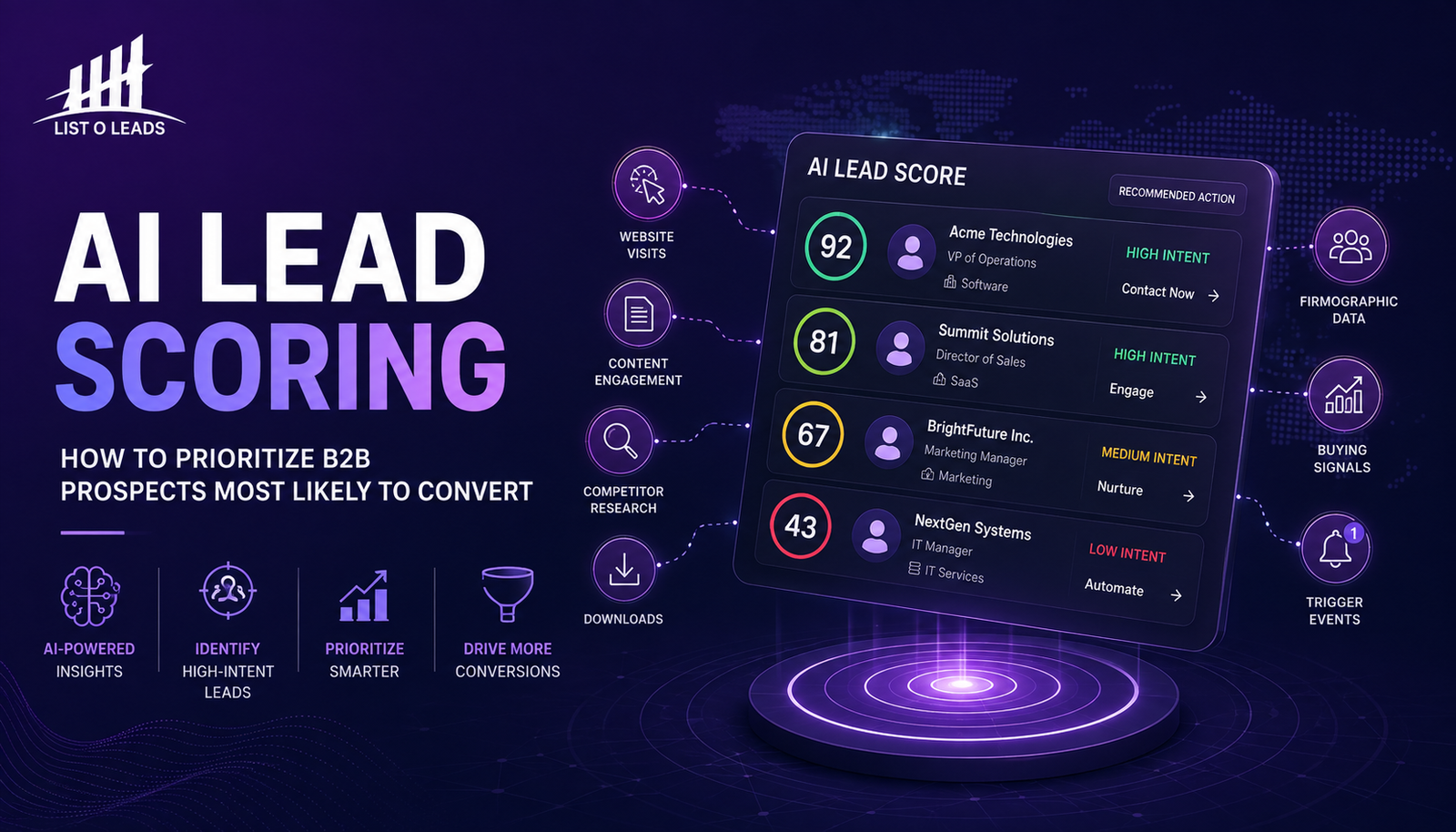
Lead Priority = Fit + Intent + Timing
For example:
Prospect A — Score: 92/100
Excellent ICP match
Correct decision-maker
Strong intent activity
Recent funding
Multiple product interactions
Action: Sales outreach immediately
Prospect B — Score: 71/100
Excellent ICP match
Correct contact
Moderate engagement
No major trigger event
Action: Nurture and monitor
Prospect C — Score: 39/100
Weak ICP match
Limited engagement
No relevant trigger signals
Action: Deprioritize
Suddenly, a database of thousands of contacts becomes a ranked sales pipeline.
How to Build an AI Lead Scoring Strategy
Technology alone won’t fix poor prospecting.
Your scoring model needs a strong foundation.
Step 1: Define Your Ideal Customer Profile
Start by identifying what your best customers have in common.
Consider:
Industry
Company size
Revenue
Geography
Business model
Technology
Decision-maker role
Without a clear ICP, even sophisticated AI can prioritize the wrong companies.
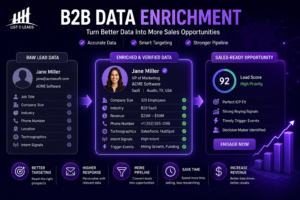
Step 2: Clean and Enrich Your B2B Data
AI is only as useful as the information it receives.
Incomplete or outdated records can weaken scoring accuracy.
Prioritize:
Valid business emails
Accurate phone numbers
Current job titles
Company information
Industry classification
Employee counts
Relevant decision-makers
Better data creates a stronger foundation for better prioritization.
Step 3: Add Buyer Intent Signals
Next, combine static prospect information with behavioral signals.
Examples include:
Website engagement
Product-page visits
Content interactions
Relevant topic research
Demo activity
Repeat visits
This helps distinguish good-fit prospects from good-fit prospects showing current interest.
Step 4: Include Trigger Events
Look for business changes that can create demand.
Funding, hiring, expansion, technology adoption, and leadership changes can make an otherwise cold prospect much more relevant.
Step 5: Connect Scores to Actions
Don’t stop at:
Lead Score: 87
Define what happens next.
For example:
80–100: Immediate sales outreach
60–79: Personalized nurture
40–59: Automated marketing sequence
Below 40: Monitor or deprioritize
Your exact thresholds should be based on your own sales cycle and historical performance.
How Can AI Lead Scoring Improve Personalization?
One of the biggest opportunities is combining prioritization with context.
Imagine your system identifies:
Company: ABC Technologies
Score: 91/100
Reason: Strong ICP fit + expansion + relevant research + senior decision-maker
Your SDR doesn’t need to begin from zero.
The outreach can focus on the business context that contributed to the score.
Instead of:
“We help businesses generate leads. Can we schedule a call?”
The salesperson can develop messaging around the prospect’s growth, market, challenges, or likely requirements.
AI can also assist marketers in analyzing large amounts of information and creating more efficient workflows.
Explore our guide to the Top AI Tools Every Marketer Should Know for additional applications of AI in marketing.
Common AI Lead Scoring Mistakes
AI doesn’t automatically make lead generation intelligent.
Avoid these common problems:
Using inaccurate prospect data
Scoring every engagement signal equally
Ignoring your Ideal Customer Profile
Relying completely on automation
Never retraining or reviewing the model
Creating scores without sales actions
Optimizing for leads instead of revenue
The most important measurement isn’t whether your model correctly predicts an MQL.
It’s whether higher-scored leads actually generate more meetings, opportunities, pipeline, and revenue.
How Should You Measure AI Lead Scoring?
Track the performance of high-scoring leads against your normal prospect population.
Useful KPIs include:
Lead-to-meeting rate
Lead-to-opportunity rate
Sales-qualified lead rate
Reply rate
Opportunity win rate
Cost per qualified lead
Pipeline generated
Sales cycle length
Revenue per lead
If leads scoring 80+ consistently convert better than leads scoring below 50, your model is providing meaningful prioritization.
If there is little difference, revisit your data and scoring logic.
AI Lead Scoring FAQ
What is AI lead scoring?
AI lead scoring uses artificial intelligence and prospect data to estimate which leads are more likely to convert or deserve sales attention.
Is AI lead scoring better than traditional lead scoring?
It can be. Traditional scoring relies primarily on predefined rules, while AI can analyze larger combinations of historical, behavioral, firmographic, and intent data.
What data is needed for AI lead scoring?
Useful data can include company information, decision-maker data, CRM history, website engagement, buyer intent signals, sales trigger events, and historical conversions.
Can small B2B companies use AI lead scoring?
Yes. You don’t necessarily need millions of leads. Even smaller businesses can benefit from combining ICP fit, engagement, intent signals, and structured prioritization.
Does AI replace SDRs?
No. AI is better viewed as a prioritization and intelligence layer. Sales representatives still provide judgment, relationship building, discovery, negotiation, and human communication.
Stop Treating Every Lead Equally
The traditional approach to B2B prospecting is simple:
Build a large list and start calling from the top.
A smarter approach asks:
Which companies fit our ICP?
Which prospects are showing meaningful intent?
Which accounts have a reason to buy now?
Which decision-makers should sales contact first?
AI lead scoring helps bring those answers together.
The future of B2B sales isn’t simply about having more leads.
It’s about knowing which leads matter most.
Turn Better Lead Data Into a Stronger Pipeline
AI can help prioritize opportunities—but it still needs quality prospect data to work with.
List O Leads helps businesses connect with targeted B2B prospects and build lead generation strategies focused on relevant audiences and stronger sales opportunities.
Stop filling your pipeline with contacts your sales team has to sort through manually.
Start with better targeting.
Get Started With List O Leads and build a smarter B2B sales pipeline.