
B2B Data Enrichment: How Better Data Creates More Sales Opportunities
Your CRM says you have 20,000 leads.
But how many are actually usable?
Some contacts have changed jobs. Others have outdated phone numbers, missing job titles, incomplete company information, or generic email addresses. Thousands may tell your sales team almost nothing about whether the company fits your Ideal Customer Profile.
A large database can look impressive while delivering very little pipeline.
This is where B2B data enrichment becomes valuable.
Data enrichment transforms basic or incomplete prospect records into more useful sales intelligence by adding, updating, and validating information about contacts and companies.
The result isn’t simply more data.
It’s better targeting, smarter prioritization, more relevant outreach, and fewer wasted sales hours.
What Is B2B Data Enrichment?
B2B data enrichment is the process of improving existing business contact and company records by adding missing information, validating existing fields, and updating outdated data.
Imagine your CRM contains this lead:
John Smith
Company: ABC Technologies
Email: john@abctech.com
That’s technically a lead—but it provides very little sales intelligence.
After enrichment, the record could contain:
Full name
Verified business email
Direct phone number
Current job title
Department
Seniority
Company name
Industry
Employee count
Revenue range
Headquarters
Technology stack
LinkedIn/company information
Recent business signals
Now your sales team has something actionable.
Why Is B2B Data Enrichment Important?
Sales teams often focus on generating new leads while overlooking the quality of the data already inside their CRM.
That’s expensive.
Poor-quality B2B data can lead to:
Emails sent to invalid addresses
Calls to incorrect numbers
Outreach to former employees
Wrong decision-makers
Poor segmentation
Inaccurate lead scoring
Duplicate records
Wasted SDR time
Data enrichment improves the foundation underneath your entire sales process.
Think of it this way:
Poor Data → Poor Targeting → Poor Outreach → Poor Pipeline
While:
Accurate Data → Better Targeting → Relevant Outreach → More Sales Opportunities
What Types of B2B Data Can Be Enriched?
Data enrichment generally covers several categories.
1. Contact Data
Contact enrichment helps identify and verify the individual prospect.
Useful fields include:
Full name
Job title
Department
Seniority
Business email
Direct phone
Professional profile
Current employer
This helps answer:
“Are we contacting the right person?”
2. Firmographic Data
Firmographic data describes the company.
Examples include:
Industry
Employee count
Revenue
Location
Company type
Headquarters
Number of locations
Growth stage
This information is essential for determining whether an account matches your ICP.
3. Technographic Data
Technographic enrichment identifies technologies a company may use.
That might include:
CRM platforms
Marketing automation
Ecommerce systems
Analytics platforms
Cloud infrastructure
Advertising technologies
Sales software
Technographic data can be especially valuable when your product integrates with—or replaces—specific technology.
4. Intent and Behavioral Data
Enrichment can also include signals showing what a prospect or account may currently be interested in.
Examples include:
Website activity
Content engagement
Product research
Topic research
Competitor comparisons
Repeat visits
Our guide to B2B Intent Data explains how these behavioral signals can help identify buyers before they contact you.
5. Sales Trigger Data
Companies constantly change.
Useful trigger information can include:
Recent funding
Rapid hiring
Executive appointments
Expansion
Product launches
Technology changes
Acquisitions
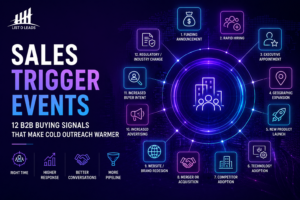
Read Sales Trigger Events: 12 B2B Buying Signals That Make Cold Outreach Warmer to see how these changes can improve outreach timing.
B2B Data Enrichment vs. Lead Generation: What’s the Difference?
These processes solve different problems.
Lead generation finds potential customers.
Data enrichment improves what you know about those potential customers.
For example, lead generation might identify:
ABC Technologies — potential SaaS prospect
Enrichment can help identify:
ABC Technologies → 450 employees → $60M estimated revenue → growing sales team → target technology detected → VP Sales identified → verified contact information
The first record tells you the company exists.
The second helps your sales team decide whether and how to approach it.
That’s why data enrichment and lead generation work best together.
How Does Better B2B Data Improve Sales?
The value of enrichment appears throughout the sales pipeline.
Better ICP Targeting
Suppose your ideal customer is:
US-based
B2B SaaS
100–1,000 employees
$10M+ revenue
Established sales department
Without enriched company data, filtering prospects accurately becomes difficult.
Enrichment allows your team to remove poor-fit accounts before SDRs waste time contacting them.
Better Segmentation
Different prospects require different messaging.
You might segment campaigns by:
Industry
Company size
Geography
Job title
Technology
Growth stage
Buying intent
A CFO shouldn’t receive the same message as a Marketing Director.
Likewise, a 20-person startup shouldn’t receive the same pitch as a 5,000-person enterprise.
Better data enables better personalization.
Better Lead Scoring
AI lead scoring depends heavily on data quality.
If your system doesn’t know the prospect’s current title, company size, industry, or buying signals, its predictions become less useful.
Enrichment provides additional inputs for prioritization.
Our guide to AI Lead Scoring explains how businesses can combine fit, intent, and timing to prioritize B2B prospects most likely to convert.
Better Sales Productivity
SDRs shouldn’t spend most of their day researching basic information.
Imagine a salesperson receives 100 leads containing only names and company websites.
They must manually determine:
Who the person is
Whether they still work there
Their position
Company size
Whether the account fits
How to contact them
Now imagine receiving those same leads already enriched and prioritized.
The salesperson can spend more time selling instead of searching.
How to Build a B2B Data Enrichment Process
Data enrichment should be systematic rather than something sales representatives perform manually when they have spare time.
Step 1: Audit Your Existing Data
Start by identifying what’s missing or unreliable.
Check:
Email validity
Phone completeness
Job titles
Company information
Duplicate records
Missing industries
Missing company sizes
Outdated contacts
This establishes your baseline.
Step 2: Define Required Fields
More data isn’t automatically better.
Determine which fields actually influence your sales process.
For many B2B teams, these include:
Contact Level
Name
Title
Department
Seniority
Email
Phone
Company Level
Industry
Employee count
Revenue
Location
Website
Sales Intelligence
Technology
Intent
Trigger events
Collect information because it improves decisions—not simply because it exists.
Step 3: Validate Existing Records
Before adding more information, make sure the basics are correct.
Validate:
Business emails
Phone numbers
Current employment
Company domains
Duplicate contacts
Incorrect enriched data can be worse than missing data because salespeople assume it’s reliable.
Step 4: Enrich Missing Information
Once records are validated, fill important gaps.
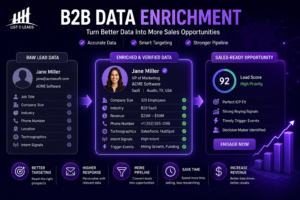
For example:
Before
Jane Miller
XYZ Software
jane@xyz.com
After
Jane Miller
VP of Marketing
XYZ Software
B2B SaaS
320 employees
Austin, Texas
Verified email
Direct business phone
Marketing automation technology identified
The second profile gives sales substantially more context.
Step 5: Add Intent and Trigger Signals
Static information tells you whether a prospect fits.
Dynamic signals can help determine when to act.
An enriched account showing:
Strong ICP Fit + Recent Funding + Hiring Growth + Buyer Intent
should probably receive more attention than a similar account showing no recent activity.
Step 6: Keep the Data Updated
Data enrichment isn’t a one-time project.
People:
Change jobs
Receive promotions
Change departments
Companies:
Grow
Shrink
Relocate
Raise capital
Change technologies
Merge
Close
Your data needs a refresh strategy.
How Can AI Improve B2B Data Enrichment?
AI can help process large datasets and identify patterns that would take humans far longer to analyze.
AI-assisted enrichment workflows can help with:
Data classification
Duplicate detection
Company categorization
Missing-field prediction
Account prioritization
Lead scoring
Research summarization
Personalization
The bigger opportunity comes from connecting enrichment with AI-driven prioritization.
Instead of simply producing:
10,000 enriched contacts
your system could surface:
150 high-fit prospects showing strong buying signals.
That’s a much more valuable sales output.
For additional applications of artificial intelligence in modern marketing, explore Top AI Tools Every Marketer Should Know.
Common B2B Data Enrichment Mistakes
Avoid these common problems:
Collecting unnecessary fields
Using outdated data
Ignoring verification
Enriching duplicate records
Treating every account equally
Never refreshing the database
Focusing on volume instead of usability
The objective isn’t to create the largest CRM.
It’s to create a database your sales team can trust and act on.
B2B Data Enrichment FAQ
What is B2B data enrichment?
B2B data enrichment is the process of improving existing contact and company records by adding missing information, validating existing fields, and updating outdated data.
What information can be added through data enrichment?
Common fields include job titles, business emails, phone numbers, company size, industry, revenue, location, technology, intent signals, and sales trigger events.
How does data enrichment help sales?
Better data improves prospect targeting, segmentation, lead scoring, personalization, and sales productivity while reducing time wasted on inaccurate or incomplete contacts.
How often should B2B data be updated?
There is no universal interval. High-value and actively worked records should generally be checked more frequently because contacts, companies, technologies, and buying signals continuously change.
Better Data Creates Better Sales Opportunities
Generating thousands of contacts means very little if your sales team can’t determine which ones matter.
Modern B2B prospecting works better when businesses combine:
Accurate Contact Data + Firmographics + Intent Signals + Trigger Events + Lead Scoring
That turns a static prospect database into actionable sales intelligence.
Instead of giving sales representatives another spreadsheet and asking them to figure everything out themselves, businesses can provide the information needed to answer:
Who should we contact?
Are they a good fit?
Who is the decision-maker?
Why should we contact them now?
That’s the real value of B2B data enrichment.
Build a More Targeted B2B Pipeline
Your sales team doesn’t need more incomplete contacts.
It needs accurate, relevant prospects that match your target market.
List O Leads helps businesses develop targeted B2B lead generation strategies focused on connecting sales teams with the right audiences and stronger opportunities.
Get Started With List O Leads and turn better prospect data into a smarter sales pipeline.