B2B Intent Data: How to Identify Buyers Before They Contact You
Most B2B companies don’t have a shortage of prospects. They have a timing problem.
Your target market might contain thousands of businesses that fit your Ideal Customer Profile (ICP), but only a small percentage may be actively looking for a solution like yours today.
So how do you separate a potential future customer from a prospect showing signs of buying right now?
That’s where B2B intent data becomes valuable.
Intent data helps sales and marketing teams identify behavioral signals associated with active research, compare those signals with ICP data, and prioritize prospects who may be closer to a purchasing decision.
Instead of asking only “Who should we target?”, businesses can start asking:
“Who should we target right now?”
What Is B2B Intent Data?
B2B intent data is behavioral information that indicates a company or prospect may be researching a particular problem, product, service, or solution.
Traditional B2B data tells you who a prospect is:
Company
Industry
Location
Revenue
Employee count
Job title
Department
Buyer intent data adds another layer by helping you understand what that prospect may currently be interested in.
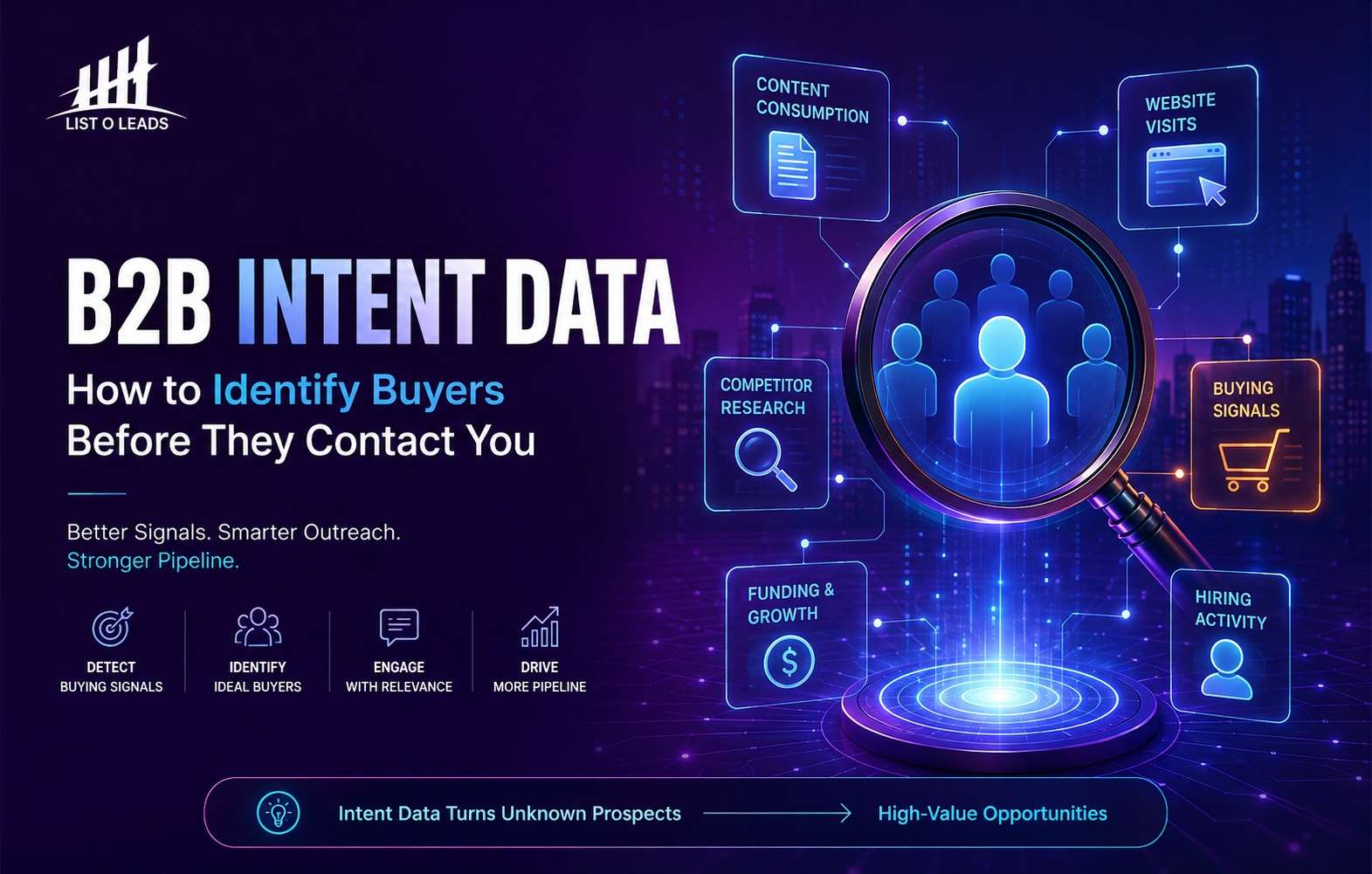
Common intent signals include:
Repeated website visits
Pricing-page activity
Product comparisons
Relevant content consumption
Webinar registrations
Competitor research
Demo-page visits
Downloads
Business expansion
Hiring activity
No single signal guarantees that a company is ready to buy. However, combining multiple signals with accurate lead data can help sales teams prioritize accounts more effectively.
Why Does B2B Intent Data Matter?
Consider two companies.
Both have 500 employees, operate in your target industry, match your preferred geography and have the right decision-makers.
Based purely on firmographic data, they look equally valuable.
But Company B has recently:
Visited your product pages several times
Researched competing solutions
Viewed pricing information
Expanded its sales team
Downloaded relevant content
Which company would you contact first?
Probably Company B.
That’s the difference between ICP targeting and intent-based targeting.
Your ICP tells you who could become a customer.
Intent signals help identify who may have a current reason to become one.
The strongest B2B prospecting strategies use both.
What Are the Three Types of B2B Intent Data?
1. First-Party Intent Data
First-party data comes directly from channels your business controls.
Examples include:
Website activity
Product-page visits
Pricing-page views
Form submissions
Email engagement
Content downloads
Webinar registrations
Demo requests
This information is particularly useful because the prospect is interacting directly with your brand.
A single blog visit may represent weak intent.
A prospect who returns multiple times, reads case studies and visits your pricing page demonstrates much stronger engagement.
2. Second-Party Intent Data
Second-party intent data originates from another organization’s first-party audience.
It can come from:
Industry publishers
Review platforms
Business marketplaces
Research communities
Content networks
This can help reveal activity that occurs before prospects reach your website.
3. Third-Party Intent Data
Third-party intent data identifies relevant research behavior across external digital sources.
For example, if a company suddenly increases its research around sales automation, lead generation, or another topic related to your solution, that activity could represent an intent signal.
It doesn’t necessarily mean:
“This company is ready to buy.”
It means:
“This account may deserve closer attention.”
Which B2B Buying Signals Should You Track?
Not every signal has the same value.
A useful B2B lead generation strategy separates general engagement from stronger commercial intent.
High-Intent Buying Signals
Watch for activities such as:
Multiple pricing-page visits
Demo requests
Product comparisons
Competitor research
Integration-page visits
Pricing requests
Repeat product-page visits
These behaviors typically occur closer to a purchasing decision.
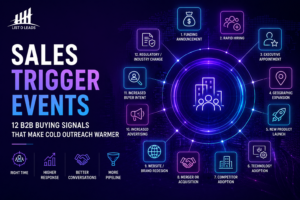
Sales Trigger Events
Behavior isn’t the only useful signal.
Changes inside a business can create new demand.
Important trigger events include:
New funding
Rapid hiring
Executive appointments
Geographic expansion
New offices
Technology changes
Mergers or acquisitions
New product launches
For example, a company that recently raised funding and started hiring 20 sales representatives may suddenly need CRM, lead generation, sales intelligence or automation solutions.
Timing your outreach around these changes can make a cold conversation significantly more relevant.
B2B Intent Data vs. Lead Data
The difference is straightforward:
Lead data tells you who the prospect is. Intent data helps explain what the prospect may currently care about.
A traditional B2B lead might contain:
Name
Business email
Phone
Company
Job title
Industry
Location
Intent intelligence adds information such as:
Research activity
Website engagement
Topics of interest
Buying-stage signals
Trigger events
Competitor research
Neither should replace the other.
The more useful model is:
Accurate B2B Data + ICP Fit + Intent Signals + Timing = Better Sales Opportunities
How to Use Intent Data for B2B Lead Generation
Intent data becomes valuable only when your sales and marketing teams can act on it.
Step 1: Define Your Ideal Customer Profile
Determine which businesses are most valuable to your company.
Consider:
Industry
Location
Company size
Revenue
Technology stack
Business model
Decision-maker roles
Intent should refine your targeting—not replace good targeting.
Step 2: Identify Meaningful Buying Signals
Determine which behaviors actually matter to your sales process.
For a B2B SaaS company, these might include:
Pricing-page visits
Competitor comparisons
Product research
Demo-page activity
Recent funding
Relevant hiring activity
Avoid treating every measurable interaction as purchase intent.
Step 3: Combine ICP Fit With Intent
Create simple account priorities.
High ICP + High Intent → Prioritize
High ICP + Medium Intent → Nurture
High ICP + Low Intent → Monitor
Low ICP + Low Intent → Deprioritize
This helps sales representatives spend more time on accounts with greater potential.
Step 4: Find the Right Decision-Makers
Company-level intent is not enough. You still need accurate contacts.
Depending on your offer, decision-makers may include:
Founder
CEO
VP of Sales
Marketing Director
Head of Growth
Operations Director
IT Director
Revenue Operations leader
For larger accounts, identify several people involved in the purchasing decision rather than relying on one contact.
Step 5: Personalize Your Outreach
Intent data should make outreach more relevant—not more invasive.
Avoid saying:
“We noticed you visited our pricing page three times.”
Instead, use available business context to improve your message.
For example:
“I noticed your company is expanding its sales operation. Teams at that stage often need a more scalable way to identify and prioritize new prospects.”
You’re turning data into context.
That’s where intent-driven outreach becomes valuable.
How Can AI Improve Intent-Based Lead Generation?
AI can analyze prospect information much faster than an SDR manually reviewing hundreds of accounts.
Modern AI-assisted workflows can evaluate:
Firmographic data
CRM history
Website engagement
Content interactions
Trigger events
Historical conversions
Intent signals
The system can then create an AI lead score.
For example:
Prospect Score: 91/100
ICP match: +25
Decision-maker identified: +15
High-intent activity: +20
Recent funding: +10
Relevant research: +12
Repeat engagement: +9
Instead of giving salespeople another massive prospect database, AI can help determine which leads deserve attention first.
For more AI-driven marketing strategies, explore our guide to Top AI Tools Every Marketer Should Know.
How Does Intent Data Improve Programmatic Advertising?
Intent intelligence can also improve paid media.
Businesses can use intent signals to:
Prioritize valuable audiences
Retarget engaged prospects
Create account-based campaigns
Coordinate ads with sales outreach
Adjust messaging by buying stage
Reduce wasted advertising spend
This connects B2B lead generation, intent data, account-based marketing and programmatic advertising into one acquisition strategy.
Learn more in our guide to Traditional vs. Programmatic Advertising Strategy.
What About Privacy and Intent Data?
Intent-based marketing still requires responsible data practices.
Businesses should consider:
Consent
Data governance
Vendor quality
Applicable privacy regulations
Data retention
First-party data strategies
As digital advertising evolves, businesses increasingly need ways to balance effective targeting with user privacy.
Our guide to The Future of Addressability in Digital Advertising explores this transition in greater detail.
Common Intent Data Mistakes
Avoid these five mistakes:
Treating every interaction as purchase intent
Ignoring ICP fit
Using outdated contact information
Making outreach feel invasive
Collecting signals without giving sales teams an action plan
Intent data isn’t valuable because you can collect more information.
It’s valuable when it helps your team make better decisions faster.
B2B Intent Data FAQ
What is B2B intent data?
B2B intent data is behavioral information that indicates a business may be researching a particular problem, product, service or solution.
What are examples of buyer intent signals?
Examples include pricing-page visits, product comparisons, competitor research, repeat website engagement, demo requests, relevant content consumption and business trigger events.
Does intent data guarantee a prospect will buy?
No. Intent data is a prioritization signal, not proof of purchase. It works best when combined with accurate B2B data, ICP fit and sales research.
Can intent data improve cold outreach?
Yes. Intent and trigger signals can help sales teams prioritize prospects and make outbound messages more relevant to the prospect’s current business situation.
Turn Buyer Signals Into Sales Opportunities
B2B lead generation is shifting from volume-based prospecting to signal-based prospecting.
The goal isn’t simply to collect more contacts.
It’s to identify:
The right company.
The right decision-maker.
The right buying signals.
The right time to engage.
Combining accurate prospect data with buyer intent, AI-assisted prioritization and personalized outreach can help sales teams spend less time chasing low-value contacts and more time building qualified pipeline.
Build a Smarter B2B Pipeline With List O Leads
Your sales team doesn’t need another massive list of random contacts.
It needs targeted prospects with real business potential.
List O Leads helps businesses build targeted lead generation strategies designed to connect sales teams with the audiences that matter most.
Get Started With List O Leads and turn better targeting into better sales opportunities.